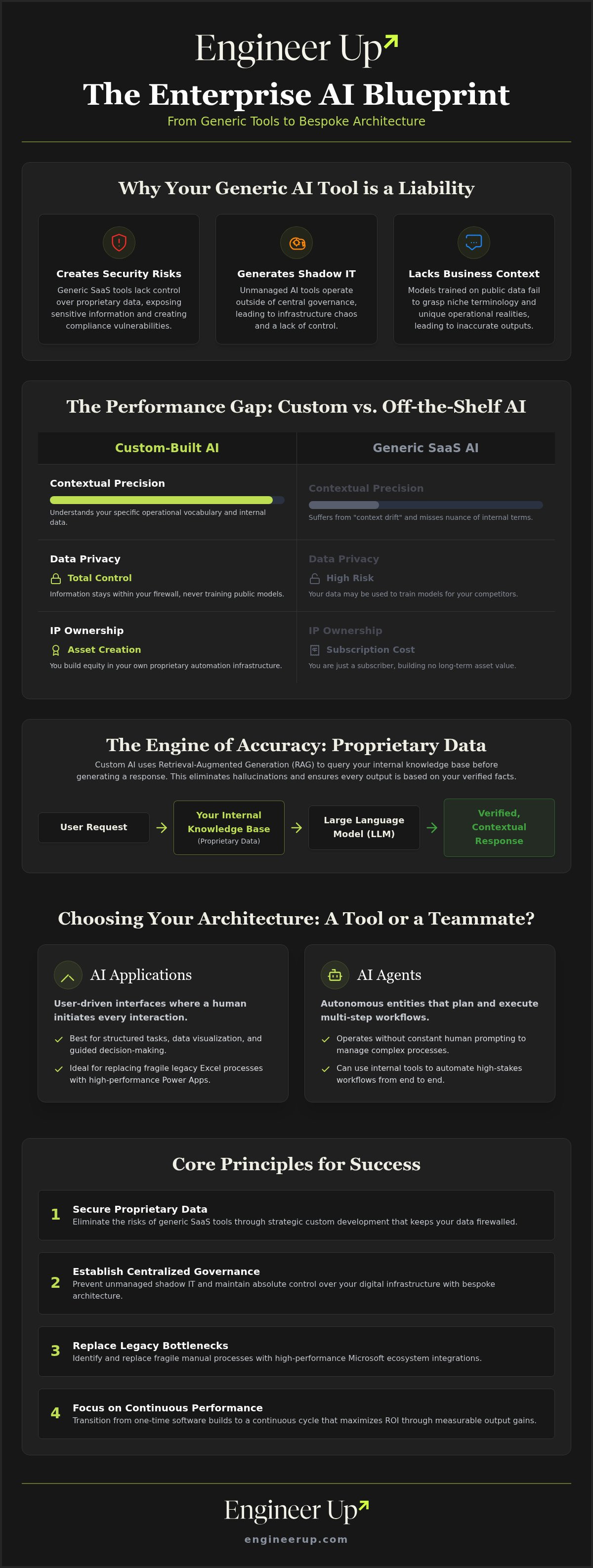
Your generic AI tool is a liability, not an asset. It lacks the context of your proprietary data and creates unmanaged shadow IT risks. Most enterprise AI initiatives fail because they rely on generic prompts rather than bespoke architecture. You already know that off-the-shelf solutions can't handle your complex legacy workflows. You've seen the limitations of models that ignore your unique operational reality and struggle to modernize outdated systems. Mastering custom ai app development for business requires a shift from generic prompts to bespoke architecture integrated with your legacy reality.
This guide provides the blueprint to master the architecture and strategic deployment of custom AI applications. We'll show you how to build secure, private models that integrate with your existing Microsoft ecosystem and automate high-stakes processes. You don't need a massive internal dev team to achieve this results-oriented outcome. We'll break down the infrastructure and scaling strategies needed to turn AI into a measurable driver of enterprise efficiency. It's time to replace fragile Excel processes with high-performance automation that actually works for your specific requirements.
Key Takeaways
• Secure proprietary data and eliminate the risks of generic SaaS tools through strategic custom ai app development for business.
• Differentiate between user-driven applications and autonomous agents to select the architecture that matches your operational needs.
• Identify legacy bottlenecks and replace fragile manual processes with high-performance Microsoft ecosystem integrations.
• Establish centralized governance to prevent unmanaged shadow IT and maintain absolute control over your digital infrastructure.
• Transition from one-time software builds to a continuous performance cycle that maximizes ROI through measurable output gains.
Defining Custom AI App Development for the Modern Enterprise
Custom AI development is the engineering of bespoke software that pairs Large Language Models (LLMs) with your proprietary data. It isn't a generic wrapper or a simple chatbot interface. These applications reside within your secure environment and operate according to your specific business logic. By 2026, the market has moved past the novelty of generative text. Performance is now the only metric that matters. Your applications must execute complex tasks, manage workflows, and interface with legacy systems. Custom AI development acts as the essential bridge between raw model power and specialized business execution.
Building these systems requires a focus on utility over hype. Generic tools often fail because they lack the structural integrity to handle enterprise-level demands. Strategic custom ai app development for business ensures that every interaction is grounded in your reality. It transforms a broad technological capability into a precise organizational tool.
Custom vs. Off-the-Shelf AI: The Performance Gap
Generic SaaS tools are built for the average user, which means they're built for no one in particular. They frequently suffer from context drift. This happens when a model fails to grasp niche industry terminology or misses the nuance of your internal acronyms. Custom solutions provide fine-tuned control over data privacy and output accuracy. You aren't just a subscriber to someone else's platform. You own the intellectual property of your automation. This ownership allows for deeper integration and a higher standard of reliability that off-the-shelf products cannot match.
Contextual Precision
Custom models understand your specific operational vocabulary.
Data Privacy
Information stays within your firewall, never training public models.
IP Ownership
You build equity in your own automation infrastructure.
The Role of Proprietary Data in Custom Development
Your proprietary data is the fuel. A custom application is the engine designed specifically for that fuel type. In 2026, Retrieval-Augmented Generation (RAG) stands as the gold standard for business accuracy. RAG allows a model to query your internal knowledge bases before it generates a response. This process eliminates the hallucinations common in public models. It ensures that every output is backed by your verified facts. Custom ai app development for business uses this architecture to create a competitive moat. While competitors rely on the same public data as everyone else, your systems leverage your unique internal knowledge to drive superior results.
This approach moves beyond simple information retrieval. It creates a system that learns and adapts to your workflow. By treating your data as a strategic asset, you turn a standard LLM into a specialized high-performer that understands your history, your clients, and your goals.
AI Applications vs. AI Agents: Choosing the Right Architecture
You must decide between a tool and a teammate. AI Applications are user-driven interfaces. A human initiates every interaction. The AI responds based on specific prompts. AI Agents are different. They are autonomous entities. They plan, use internal tools, and execute multi-step workflows without constant human prompting. The choice between these two architectures depends on the complexity of the task and the level of oversight your organization requires. Success in custom ai app development for business starts with selecting the right structural framework for the job.
Most organizations benefit from a hybrid approach. You need the stability of structured applications and the agility of autonomous agents. Architecting within the Microsoft ecosystem allows for this flexibility. Leveraging the Power Platform ensures rapid, secure deployment that integrates directly with your existing data. It's about building a system that fits your reality rather than forcing your business to adapt to the software.
When to Build a Custom AI App
Custom applications are best for data visualization, guided decision-making, and structured input tasks. Many organizations still rely on legacy Excel processes that are fragile and prone to error. These manual workflows are prime candidates for modernization. Replacing them with high-performance Power Apps provides a secure, centralized environment for your data. This approach ensures a familiar UI for your employees. It reduces friction. It eliminates the need for massive training programs. By focusing on structured utility, you create a reliable foundation for custom ai app development for business that delivers immediate operational value.
The Rise of Autonomous AI Agents for Business
Agents excel at unstructured tasks where the path to a solution isn't linear. Think of supply chain troubleshooting or complex HR onboarding. These entities don't just provide information; they act. By integrating agents with existing APIs, the AI can trigger external software to solve problems in real-time. Governance is the priority here. You must establish strict guardrails to ensure agents operate within defined business parameters. High-performance organizations use these autonomous entities to assume the burden of complex technical challenges. If you want to scale output without a massive internal dev team, specialized AI agents provide the necessary momentum to automate high-friction manual tasks effectively.
The Custom Development Lifecycle: Integrating AI into Legacy Workflows
Success in custom ai app development for business is the result of a methodical lifecycle. It isn't a series of experiments. It's a structured engineering process. You must move from identifying friction to deploying a scalable solution without disrupting existing operations. This requires a deep respect for your current infrastructure and a clear vision for its modernization. High-performance development isn't just about writing code; it's about aligning technology with operational reality.
Step 1: Process Audit.
Identify high-friction manual tasks. Locate the legacy bottlenecks that drain your team's time.
Step 2: Architecture Design.
Select the right LLM for the task. Use GPT-4o for complex reasoning or Llama 3 for specialized local processing. Map the integration points carefully.
Step 3: Data Engineering.
Legacy data is often messy. You must clean and structure it so the AI can consume it accurately. Performance depends on the quality of this foundation.
Step 4: Iterative Development.
Build MVPs first. Solve one high-value problem before expanding. This ensures immediate ROI and allows for rapid adjustments.
Step 5: Deployment and Support.
Scale the application across the enterprise. Ensure the IT department maintains control to prevent shadow IT risks.
Modernizing Legacy Systems with AI Integration
Custom AI acts as a high-performance wrapper for your aging ERP or CRM systems. It bridges the gap between old data structures and modern intelligence. You don't need to rip and replace your entire stack to see results. Instead, use intelligent document processing to eliminate manual data entry. Many organizations successfully transition from fragile Excel-based project management to centralized, AI-driven applications. This approach preserves your historical data while providing the speed of modern automation. It turns a legacy liability into a functional asset.
The Importance of a Specialized AI Development Firm
Generalist agencies often lack the deep architectural knowledge required for secure enterprise integration. They focus on the "AI" but ignore the "Business App" utility. Boutique firms provide better alignment with your specific objectives. They understand that custom ai app development for business isn't just about code; it's about operational results. The Engineer Up approach prioritizes direct communication and technical mastery. We focus on being doers rather than talkers. We assume the burden of complex technical challenges so you can remain focused on your primary goals. You need a partner who values structural integrity and tangible outcomes over marketing buzzwords.
Security, Governance, and Scaling Custom AI Solutions
Security isn't a feature; it's the foundation of every enterprise system. Without absolute data sovereignty, your AI initiative is a liability. High-performance custom ai app development for business ensures your proprietary information never leaves your secure environment to train public models. You must maintain total control over your intellectual property. Centralized development prevents the rise of shadow IT. When employees lack secure tools, they turn to unmanaged external platforms. This creates massive security gaps. By providing a sanctioned, custom-built ecosystem, you keep the IT department in the driver's seat while empowering the rest of the organization.
Scaling requires moving from a single pilot application to a horizontal ecosystem of specialized agents. This transition must be managed carefully. A Governance Framework is mandatory for scaling Power Platform deployments without introducing operational or security risks. You need a structured approach to ensure that as you add more tools, you don't add more vulnerability. Expansion shouldn't lead to technical debt. It should lead to increased capacity.
Enterprise-Grade Security Protocols
Your architecture must include Multi-Factor Authentication (MFA) and Role-Based Access Control (RBAC). These aren't optional. They ensure that only authorized personnel interact with sensitive data layers. Encryption standards for data at rest and in transit are equally critical within AI workflows. Custom architecture allows you to meet specific compliance requirements like SOC2, HIPAA, or GDPR. We build systems that respect these legal boundaries from the first line of code. This isn't just about ticking boxes; it's about protecting the structural integrity of your business data against external threats and internal leaks.
Scaling Without Complexity
Growth requires efficiency. We utilize modular code that allows multiple applications to share a single, centralized AI "brain." This reduces redundancy and simplifies maintenance. As the system grows, monitoring performance is vital to prevent hallucinations. You need real-time quality control to ensure outputs remain accurate and grounded in your specific data. Strategy consulting plays a key role here. It helps you plan a long-term AI roadmap that aligns with your evolving goals. If you're ready to secure your data and scale your operations, partner with Engineer Up to build a resilient AI infrastructure that drives measurable growth.
Maximizing ROI Through Strategic AI Consulting and Ongoing Support
AI development isn't a one-time transaction. It is a continuous performance cycle. Deploying a tool is the start, not the finish line. To extract maximum value from custom ai app development for business, you must treat your applications as living assets. They require maintenance, tuning, and strategic oversight to remain competitive. A static system is a failing system. High-performance organizations prioritize long-term technical mastery over short-term fixes. This approach ensures your investment continues to yield returns as your business scales and your data grows.
The ROI of Custom Automation
Efficiency isn't a buzzword. It's a metric. You must calculate the Cost of Inaction (COI) for your manual legacy processes. Every hour spent on repetitive data entry or manual reconciliation is capital wasted. For example, a custom finance agent can reduce month-end closing time by 70%. This isn't just about saving time. It's about increasing output capacity and reducing human error. You move from reactive troubleshooting to proactive strategy. Measuring ROI means tracking these tangible outcomes with precision.
Time Recovery
Reclaim hundreds of hours previously lost to manual data manipulation.
Error Mitigation
Eliminate the costly mistakes inherent in manual Excel workflows.
Output Velocity
Execute complex tasks at a speed that human teams cannot match.
Technology in 2026 and 2027 will evolve rapidly. Your AI models need regular updates to leverage new capabilities and maintain structural integrity. Ongoing support ensures your systems don't become obsolete within months of deployment. Strategic custom ai app development for business includes a roadmap for these updates. It ensures your infrastructure stays ahead of market shifts and technical debt, and you can discover The Code Factory to help with specialized code remediation and production readiness reviews. You need a system that adapts to new LLM releases and integration standards without requiring a total rebuild.
We provide elite specialized support to maintain 99.9% uptime for your business-critical AI applications. We assume the burden of technical stability so you stay focused on your primary goals. Our strategy consulting ensures your long-term roadmap remains aggressive and effective. We don't just build software; we engineer stability. You need a partner who values results and direct communication. We focus on the "doers" who need systems that work every time. If you're ready to move beyond "talking" and start "doing," it's time to secure your competitive advantage. Consult with Engineer Up for high-performance AI development and take control of your technical future.
Engineering Your Competitive Edge
Bespoke AI isn't a luxury. It's the standard for 2026 enterprise performance. Moving beyond generic prompts allows for secure data sovereignty and deep legacy integration. You must choose between user-driven apps and autonomous agents based on your specific operational friction. Success in custom ai app development for business requires a rigorous lifecycle and a commitment to ongoing optimization. It's the difference between a tool that talks and a system that executes.
Engineer Up delivers this technical mastery. We're specialized Microsoft ecosystem experts who prioritize no-nonsense, outcome-focused delivery. We assume the burden of complex architecture so you can stay focused on your primary goals. Our ongoing strategic and technical support ensures your systems scale without creating unmanaged shadow IT risks. We don't just build software; we engineer stability and measurable ROI.
Your data is ready for a higher level of execution. Stop settling for off-the-shelf limitations and start building the infrastructure your business deserves. Partner with Engineer Up for Custom AI Development to transform your legacy processes into high-performance assets. Your future architecture starts today.
Frequently Asked Questions
What is the typical timeline for custom AI app development?
Timelines for custom ai app development for business vary based on architectural complexity. A functional MVP typically requires 4 to 12 weeks of engineering. This period covers process auditing, data structuring, and iterative testing. More complex autonomous agents requiring deep legacy integration may extend this window. We prioritize speed without sacrificing structural integrity. Our focus remains on delivering a high-performance solution that integrates seamlessly into your existing Microsoft ecosystem.
How much does custom AI development for business cost?
Investment levels depend entirely on the scope of the project and the complexity of your data. Factors include the number of integration points, the choice of LLM, and the depth of the required automation. We focus on outcome-based value rather than generic pricing models. Each project is engineered to replace high-friction manual tasks with measurable efficiency. A detailed technical audit is necessary to provide an accurate assessment of the resource requirements for your specific objectives.
Can custom AI apps integrate with our existing legacy Excel processes?
Yes. Custom AI applications are designed specifically to bridge the gap between legacy Excel processes and modern intelligence. We replace fragile, manual spreadsheets with secure Power Apps that leverage your historical data. This transition eliminates manual entry errors and centralizes information within your existing Microsoft ecosystem. It turns a legacy liability into a functional, automated asset. Your historical data remains intact while your operational speed increases through intelligent processing.
Is our business data safe when using custom AI applications?
Your business data remains secure within your private environment. We ensure absolute data sovereignty by preventing your proprietary information from training public models. Our architecture utilizes enterprise-grade encryption and Role-Based Access Control to maintain strict security standards. Unlike generic SaaS tools, custom applications reside within your sanctioned firewall. This approach eliminates the risk of shadow IT while meeting critical compliance requirements like SOC2 or GDPR. Security is our foundational priority.
What is the difference between an AI app and an AI agent?
The difference lies in autonomy. An AI app is a user-driven interface where a human initiates every action and prompt. An AI agent is an autonomous entity capable of planning and executing multi-step workflows without constant human oversight. Apps are ideal for structured data visualization and decision support. Agents excel at managing unstructured tasks like supply chain troubleshooting. Both architectures can be integrated into a single ecosystem to maximize your operational capacity.
Why should we hire an AI consulting firm instead of using off-the-shelf tools?
Off-the-shelf tools lack the context of your proprietary data and unique business logic. They often lead to context drift and accuracy issues. Investing in custom ai app development for business through a specialized firm provides bespoke architecture tailored to your specific requirements. This ensures you own the intellectual property of your automation rather than renting a generic interface. We assume the burden of complex technical challenges so you remain focused on your primary goals.
Do we need a large internal IT team to support custom AI apps?
You don't need a massive internal dev team to deploy custom AI. We assume the role of your specialized technical partner, handling everything from architecture design to ongoing support. Our systems are built on the Microsoft Power Platform for easier maintenance and centralized governance. We provide the technical mastery and elite reliability required to keep your systems running at peak performance. This allows your existing team to focus on high-value strategic objectives while we manage the infrastructure.
How do we measure the ROI of custom AI automation?
Measuring ROI requires tracking tangible metrics like time saved and error reduction. Calculate the Cost of Inaction for your current manual processes to establish a baseline. Focus on increased output capacity and the speed of month-end closings or document processing. Efficiency is a measurable metric, not a vague goal. By replacing high-friction manual tasks with automation, you see direct gains in operational velocity. We help you track these outcomes to ensure your technical investment drives measurable growth.
WRITTEN BY
Get Your Team AI Ready
Let's hear your use case - we'll help you get on the path to AI readiness.

FILED UNDER
TOOLS IN THIS POST