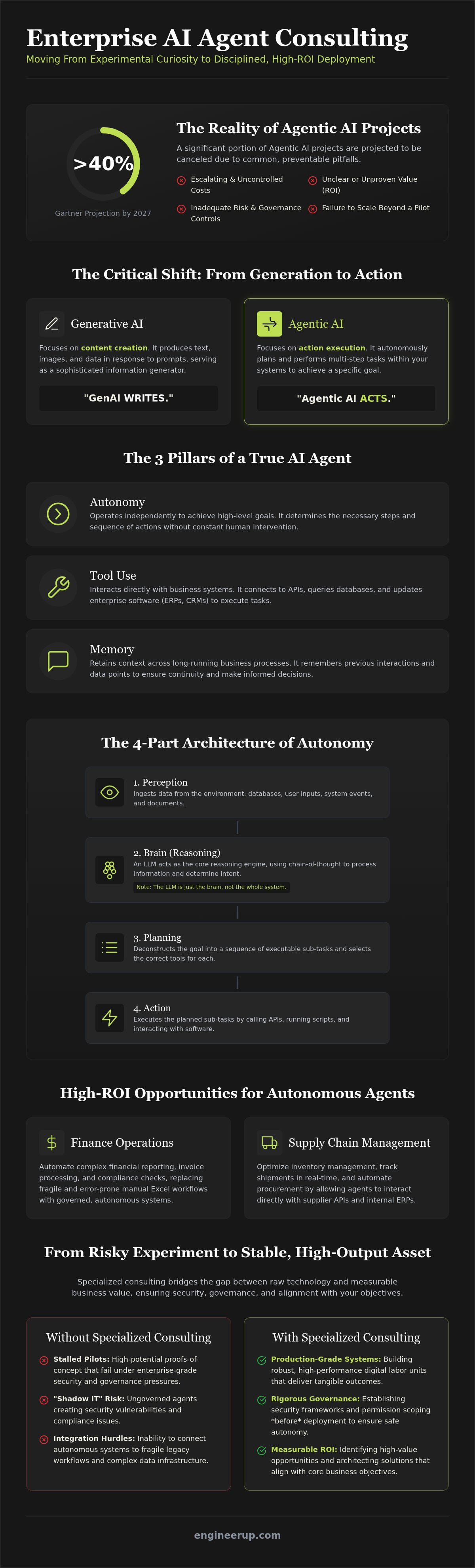
Gartner projects that over 40% of agentic AI projects will be canceled by the end of 2027 due to escalating costs, unclear value, or inadequate risk controls. It's a sobering reality for leaders tired of inefficient legacy workflows and failed AI proofs-of-concept. You've likely seen high-potential pilots stall because they lacked the structural integrity to handle enterprise-grade security and governance. Most systems aren't truly autonomous; they're just reactive scripts that fail under pressure.
Professional enterprise ai agent consulting transforms these experiments into high-performance assets. This guide explains how specialized engineering bridges the gap between raw technology and measurable ROI. You'll move past the hype to see how autonomous agents function as reliable labor units within your existing Microsoft ecosystem. We provide a clear roadmap for implementation, a deep dive into production-grade architecture, and the specific frameworks needed to validate ROI in 2026. This is about moving from experimental curiosity to a disciplined, results-oriented deployment.
Key Takeaways
• Understand the shift from Generative AI to Agentic AI and why autonomous action execution is the new standard for enterprise efficiency.
• Master the four-part architectural framework of Perception, Brain, Planning, and Action that allows agents to reason and execute complex tasks.
• Identify high-ROI opportunities in Finance and Supply Chain where autonomous agents replace fragile, manual legacy processes.
• Leverage specialized enterprise ai agent consulting to bridge the gap between raw technical architecture and measurable business value.
• Build a production-grade roadmap by auditing your data infrastructure and establishing strict governance for autonomous decision-making.
What is Enterprise AI Agent Consulting? Defining Autonomous Business Systems
Enterprise AI agents represent a fundamental shift in corporate computing. They aren't merely sophisticated chatbots designed for conversation. Instead, these systems function as an Intelligent Agent; they are autonomous software entities that plan and execute multi-step workflows without constant human intervention. While Generative AI focuses on content creation, Agentic AI focuses on action execution. This distinction is critical for leaders seeking measurable ROI. GenAI writes. Agentic AI acts. The difference is execution.
Standard off-the-shelf bots often lack the precision required for complex operations. They struggle with proprietary data and fail to navigate specific business logic. Professional enterprise ai agent consulting bridges this gap. It moves beyond raw Large Language Model (LLM) capabilities to build systems that actually work within your existing infrastructure. Consultants turn raw reasoning engines into disciplined digital labor units.
The Core Capabilities of an AI Agent
True agents possess three defining characteristics that separate them from simple automations:
Autonomy
They operate independently. Once given a high-level goal, they determine the necessary steps to achieve it.
Tool Use
They don't just talk about data; they interact with it. They connect to APIs, query databases, and update enterprise software.
Memory
They retain context across long-running business processes. They remember previous interactions and data points to ensure continuity.
Why Enterprises Need Specialized Strategy Consulting
The market is saturated with AI hype. Most companies don't need another pilot program; they need a production-grade system that delivers tangible outcomes. High-performance enterprise ai agent consulting identifies where these units provide the most value. It prevents the risks of "shadow IT" by establishing rigorous governance frameworks before the first line of code is written.
Integrating these agents into complex legacy environments is a massive technical hurdle. You can't simply plug an autonomous system into a fragile, manual Excel-based workflow and expect stability. It requires deep architecture knowledge. Specialists assume the burden of this technical complexity. They ensure the agents are secure, governed, and aligned with your broader business objectives. This professional oversight turns a risky experiment into a stable, high-output asset. It moves the burden of technical mastery from your internal team to specialized experts; organizations that wish to empower their staff through foundational education can visit Trainetics Academy.
The Architecture of Autonomy: How Enterprise AI Agents Function
Deploying a production-grade agent requires more than a simple API call to an LLM. It demands a robust four-part architectural framework: Perception, Brain, Planning, and Action. Perception allows the system to ingest data from your environment, often integrating specialized semantic tools from Ubestream - AI Translation Service Provider for multilingual data processing. The Brain provides the reasoning logic. Planning breaks down complex goals into logical steps. Action executes those steps through external tools. Large Language Models (LLMs) serve strictly as the reasoning engine, not the entire system. Without the other three components, an agent is just a chatbot without a chassis. Professional enterprise ai agent consulting ensures these components integrate seamlessly into your existing stack.
Agents utilize chain-of-thought prompting to decompose high-level business objectives into executable sub-tasks. This reasoning process allows the system to handle ambiguity that would break traditional automation. While RAG (Retrieval-Augmented Generation) provides the agent with specific company knowledge, specialized fine-tuning can sharpen its performance for niche industry logic. The agent selects the appropriate tool by matching the semantic intent of the current sub-task against the documented capabilities of available APIs. This isn't guesswork; it's a calculated selection based on the agent's internal reasoning logic.
Tool Use and API Integration
For an agent to provide value, it must interact with your business world. This involves deep integration with ERPs, CRMs, and custom AI-Apps Development. Autonomy doesn't mean a lack of control. Secure authentication and precise permission scoping are mandatory for any autonomous action. We manage these risks by deploying agents within a 'sandbox' environment. This allows for safe experimentation and rigorous testing before an agent touches live production data. It's about building a cage for the power, ensuring it only goes where it's directed.
High-stakes enterprise decisions still require a Human-in-the-Loop (HITL) requirement. You don't let an agent authorize a million-dollar purchase without a signature. Instead, the agent prepares the data, justifies the reasoning, and waits for human validation. Within the Microsoft ecosystem, we leverage secure data connectors to ensure that these autonomous actions remain within established compliance boundaries. This architecture provides the speed of AI with the safety of traditional governance. If you're ready to build a system that actually delivers, specialized enterprise ai agent consulting provides the technical blueprint you need to succeed.
Strategic Use Cases: Where AI Agents Drive Maximum ROI
ROI in AI isn't found in generating text. It's found in executing work. Traditional Robotic Process Automation (RPA) handles structured tasks with rigid, brittle rules. If a UI element moves or a field name changes, RPA breaks. AI agents handle unstructured tasks with reasoning and adaptability. This is the core value proposition of enterprise ai agent consulting. We replace fragile, manual legacy processes with autonomous units that actually update systems. The era of the "Excel-based workflow" is ending. High-performance agents assume the labor of repetitive data entry and validation.
Finance and Operations Automation
Finance is a primary target for high-performance automation. Agents perform autonomous reconciliation and intelligent document processing. Industry data suggests AI agent accuracy in data processing has reached 98%. This level of precision is vital for managing complex tasks like vendor onboarding and invoice dispute resolution. The agent doesn't just flag a discrepancy. It investigates the cause across multiple systems and executes the correction. This reduces the margin of error in multi-step financial workflows significantly. It turns a week-long manual audit into a real-time autonomous process.
Supply Chain and Logistics Intelligence
Supply chain management requires constant reaction to external variables. AI agents monitor inventory levels in real-time. They don't wait for a human to notice a shortage; they autonomously draft purchase orders based on predictive demand and current lead times. Predictive logistics allow agents to react to port delays or weather events instantly. They shift routes or notify partners before the bottleneck occurs. This streamlines communication between disparate supply chain partners who traditionally operate in silos. The agent acts as a digital coordinator across the entire value chain.
The transition from "Chat" to "Work" is the defining trend of 2026. Enterprises are moving away from bots that answer questions to agents that move data and update core systems of record. This shift requires a disciplined approach to architecture. Specialized enterprise ai agent consulting ensures these use cases aren't just theoretical pilots. They become high-performance assets integrated into the Microsoft ecosystem. We assume the technical burden of these complex integrations so your leadership can focus on strategic outcomes. You gain a workforce of agents that never sleep and rarely err.
The Enterprise Readiness Roadmap: Preparing for Agentic Deployment
Audit your data infrastructure before writing a single line of code. High-performance agents require accessible, clean, and structured data to reason effectively. If your data is siloed or inconsistent, your agent will hallucinate or stall. Specialized enterprise ai agent consulting begins with this technical audit. We identify the specific systems of record that must be exposed to the agentic brain. You don't need a perfect data lake; you need a reliable data pipeline. Without this foundation, even the most advanced LLM will fail to execute meaningful work.
Identify your first pilot by targeting low-risk, high-frequency tasks. Avoid high-stakes customer-facing roles during the initial phase. Instead, focus on internal operations like automated data entry, document triage, or multi-step report generation. These wins validate the architecture and build internal trust. Success in these areas provides the telemetry needed to establish performance benchmarks. You must define what "good" looks like before you scale. Scaling a system without professional enterprise ai agent consulting often leads to fragmented "shadow IT" risks that compromise security.
Governance and Risk Management
Governance is the anchor of autonomous systems. You must define who is responsible for an agent's autonomous action before deployment. We implement strict guardrails to prevent reasoning errors from becoming business actions. Every action an agent takes must be logged in a permanent, searchable audit trail. These actions must be reversible; a system that can't undo an error isn't enterprise-ready. We leverage Power Apps Consulting Services to build governed environments where these agents can operate safely. This ensures that autonomy never comes at the expense of corporate security.
Scaling from Pilot to Production
Scaling requires a disciplined approach to feedback loops. High-performance agents learn from their environment, but they require human oversight to refine their logic. We implement monitoring protocols that flag outliers for immediate review. This iterative refinement is a core part of our ongoing support model. You must also consider infrastructure requirements. Some agents require the low latency of Edge deployment while others thrive on the massive compute of the Cloud. Finally, train your workforce to collaborate with these digital teammates. This isn't about replacement; it's about shifting human labor to higher-value strategic tasks.
Effective deployment requires a partner who understands the full lifecycle of an autonomous system. If you're ready to move from pilot to production, our strategy consulting provides the technical roadmap for long-term ROI. We assume the burden of technical mastery so your team can remain focused on your primary business goals.
Engineering High-Performance Agents: The Value of Specialized Consulting
Generalist agencies often fail at agentic AI because they treat it as a marketing exercise. They lack the deep architecture knowledge required to build autonomous systems that withstand enterprise pressure. High-performance enterprise ai agent consulting is a technical discipline, not a creative one. Engineer Up operates as a specialized doer. We assume the heavy lifting of technical mastery. This allows your leadership to focus on primary business objectives while we build the digital labor force. We prioritize the Microsoft ecosystem because it represents the gold standard for enterprise stability and security. It provides the structural integrity necessary for high-stakes automation.
A specialized partner doesn't just deliver a script and leave. They understand that autonomous agents are labor units that require ongoing support to remain effective. We assume the technical burden so you don't have to hire a massive internal team of AI engineers. This professional implementation ensures that your agents are integrated deeply into your systems of record. It turns a risky experiment into a stable, high-output asset. We focus on the quality of the output rather than superficial features. This is a commitment to elite reliability and tangible business value.
Beyond Deployment: The Lifecycle of an AI Agent
A deployed agent is a living system. It isn't a static piece of code. Business environments shift; markets change; logic that worked yesterday might fail tomorrow. Agents require constant tuning to maintain accuracy and performance. Without professional oversight, systems succumb to model drift. This is a gradual decline in reasoning quality as the underlying data or environment evolves. We provide ongoing support to monitor these systems and manage these risks. Our strategy consulting identifies the next phase of automation, ensuring your agents grow alongside your business. Reliability isn't a one-time event. It's a continuous commitment to structural integrity.
Choosing the Right Consulting Partner
Avoid buzzword agencies that prioritize self-congratulation over substance. Look for technical mastery and transparent communication. A serious partner focuses on tangible outcomes and measurable ROI. They understand the difference between a simple chatbot and an autonomous labor unit. You need a firm that assumes the burden of complex technical challenges. We value a strong work ethic and high-performance standards. This is about building systems that work, not just talking about them. Our enterprise ai agent consulting focuses on the mechanics of execution. Contact Engineer Up today for an AI Agent Readiness Assessment to evaluate your infrastructure and define your roadmap.
Deploying the Future of Autonomous Enterprise Labor
The transition from generative experimentation to agentic execution is the defining shift of 2026. You've seen how a robust architecture turns raw reasoning into a disciplined labor unit capable of transforming Finance and Supply Chain workflows. Success isn't about the model you choose; it's about the structural integrity of the system you build around it. By auditing your data infrastructure and establishing rigorous governance, you move beyond fragile legacy processes into an era of high-performance automation.
Professional enterprise ai agent consulting ensures these systems remain accurate, secure, and aligned with your strategic goals. We provide specialized Microsoft ecosystem expertise and end-to-end strategic consulting to bridge the gap between technology and ROI. With our high-performance support models, your autonomous agents will continue to deliver value as your business evolves. Don't let your AI strategy stall at the pilot phase. It's time to assume control of your digital future and deploy systems that work.
Drive Efficiency with Custom Enterprise AI Agents
The path to autonomous efficiency is clear. Start building your high-performance workforce today.
Frequently Asked Questions
What is the difference between an AI chatbot and an AI agent?
AI chatbots focus on conversation and content generation. AI agents focus on action and execution. While a chatbot answers questions about a policy, an agent autonomously updates that policy across your ERP and CRM systems. Agents possess reasoning capabilities that allow them to plan multi-step workflows without human prompts. They are digital labor units rather than simple communication interfaces. This distinction is the foundation of high-performance enterprise ai agent consulting.
Can AI agents integrate with our existing legacy systems?
AI agents integrate with legacy systems through secure API connectors or robotic process automation bridges. You don't need to overhaul your entire infrastructure to gain value. We specialize in connecting autonomous agents to manual, Excel-based workflows and older databases. This approach stabilizes fragile processes by adding a layer of intelligent orchestration. The agent assumes the burden of data movement, ensuring your legacy systems remain functional while benefiting from modern AI reasoning.
How do we ensure an AI agent doesn't make a critical business error?
We prevent critical errors by implementing Human-in-the-Loop (HITL) protocols for high-stakes decisions. Agents operate within strict guardrails that define their permission levels and spending limits. Every autonomous action is logged in a searchable audit trail, allowing for immediate reversal if necessary. We also utilize sandbox environments for rigorous testing before any agent touches production data. This multi-layered governance framework ensures that autonomy never translates into uncontrolled risk for your business.
What is the typical ROI timeline for enterprise AI agent consulting?
Most organizations see initial efficiency gains within the first 90 days of a pilot deployment. Full ROI typically materializes between six and twelve months as agents scale across multiple departments. The timeline depends on the complexity of your data infrastructure and the frequency of the tasks being automated. Specialized enterprise ai agent consulting accelerates this process by identifying high-impact use cases early. This disciplined approach ensures that your investment yields measurable performance improvements quickly.
Do we need to move all our data to the cloud to use AI agents?
You don't need to move all your data to the cloud to deploy AI agents. We build hybrid architectures that allow agents to access on-premises databases securely. While cloud environments offer massive compute power for reasoning engines, many agents operate effectively at the edge or within private data centers. We audit your existing setup to determine the most efficient hosting model. This flexibility ensures that your data remains where it is most secure and accessible.
How does Engineer Up handle ongoing support for deployed agents?
Engineer Up provides comprehensive ongoing support through proactive performance monitoring and logic tuning. We manage model drift to ensure your agents remain accurate as your business environment evolves. Our team assumes the technical burden of maintenance, allowing your internal staff to stay focused on strategic goals. This support model includes regular readiness assessments and updates to the agent's toolset. We treat your agents as a long-term workforce that requires consistent optimization for peak performance.
What role does the Microsoft Power Platform play in AI agent deployment?
The Microsoft Power Platform serves as the primary infrastructure for governed agent deployment. We use Power Apps to create user interfaces for Human-in-the-Loop interactions and Power Automate to handle the agent's tool-use execution. This ecosystem provides the secure data connectors and compliance frameworks required for enterprise-grade stability. By leveraging these tools, we ensure that your autonomous systems are built on a reliable, scalable foundation that integrates seamlessly with your existing Microsoft 365 environment.
Is enterprise AI agent consulting suitable for mid-sized organizations?
Mid-sized organizations benefit significantly from AI agents because they level the playing field against larger competitors. Agents allow smaller teams to handle enterprise-scale workloads without hiring additional headcount. By automating repetitive administrative and operational tasks, mid-sized firms can redirect their resources toward innovation and growth. Our strategy consulting helps these organizations identify the most cost-effective entry points for automation. This ensures that the deployment remains lean while delivering high-performance outcomes that drive long-term stability.
WRITTEN BY
Get Your Team AI Ready
Let's hear your use case - we'll help you get on the path to AI readiness.

FILED UNDER
TOOLS IN THIS POST