Deployment is the beginning, not the end. Most enterprise AI systems degrade within months due to unmonitored drift and silent API updates. You've likely realized that standard IT protocols cannot handle the non-deterministic nature of large language models. This is why specialized technical support for ai apps has become the defining factor between a failed experiment and a scalable asset. Reliability requires more than just keeping the server running. It requires active integrity management.
We understand the frustration of seeing a once-perfect prompt start producing hallucinations or breaking after a Microsoft platform update. This drains your internal resources and creates unacceptable risks for your business logic. This article delivers the 2026 Enterprise Maintenance Framework. It's a professional roadmap designed to secure your uptime and protect model integrity. We will detail how to manage breaking changes, eliminate output decay, and transition from reactive troubleshooting to long-term strategic optimization.
Key Takeaways
• Traditional support models fail non-deterministic systems. Learn to prioritize output integrity over basic server uptime to maintain reliability.
• API lifecycles and data hygiene require constant vigilance. Master the core pillars of maintaining clean RAG pipelines and stable model connections.
• Model drift is silent and destructive. Establish a production benchmarking framework to detect and neutralize hallucinations before they impact your business logic.
• Specialized technical support for ai apps eliminates the burden of elite hiring. Secure your ecosystem without the overhead of building internal R&D teams.
• Transition from reactive fixes to strategic optimization. Managed performance is the only path to sustainable enterprise ROI in a rapidly shifting landscape.
Defining Technical Support for AI Apps in an Enterprise Context
Technical support for ai apps is the specialized discipline of maintaining model performance, data integrity, and API stability. Traditional software support models rely on deterministic logic. If the code is correct and the server is on, the output is guaranteed. AI breaks this paradigm. Large language models (LLMs) are non-deterministic. A system can be online while producing toxic, inaccurate, or irrelevant results. This shift requires a new framework for operational excellence.
Day 1 development focuses on building the engine. Day 2 operational support focuses on keeping that engine tuned as the environment shifts. Enterprise-grade AI agents require elite reliability to remain business-critical. Without a dedicated framework, these assets quickly become liabilities. Managed performance is the only way to ensure that your initial investment continues to deliver ROI long after the initial deployment phase.
The Shift from Uptime to Integrity
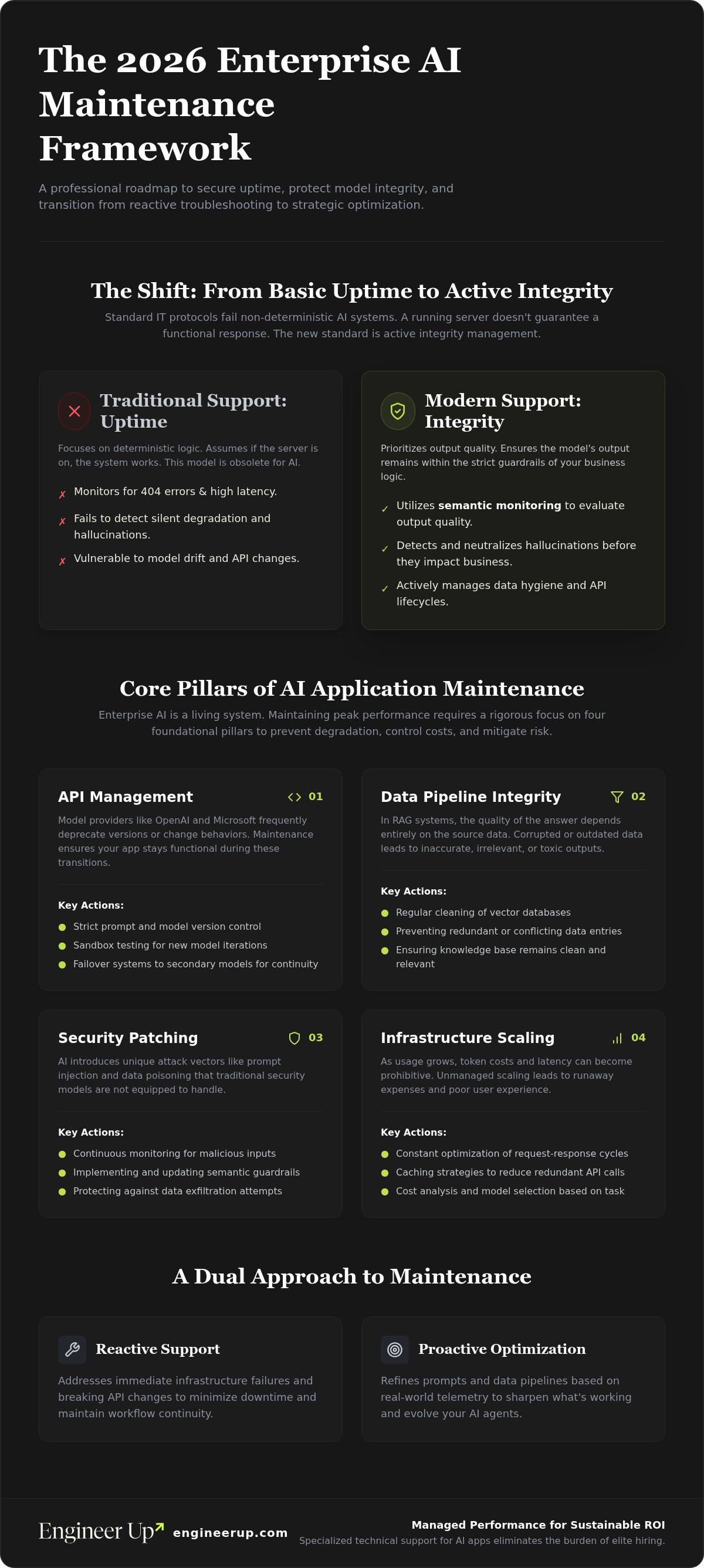
A running server doesn't guarantee a functional AI response. In the enterprise context, integrity means the model's output remains within the strict guardrails of your business logic. Traditional monitoring looks for 404 errors or high latency. Modern technical support for ai apps utilizes semantic monitoring. This involves evaluating the mathematical distance between the intended answer and the actual output. It detects silent failures where the app technically works, but the intelligence has degraded. If your RAG (Retrieval-Augmented Generation) system starts pulling from outdated documents, your uptime is irrelevant because your integrity is gone.
Support vs. Optimization: A Dual Approach
Effective maintenance requires a dual-track strategy. Reactive support addresses immediate infrastructure failures. This includes managing breaking API changes from providers like OpenAI or Microsoft. If an endpoint changes, the app stops. You need a partner who anticipates these shifts before they crash your workflow.
Proactive optimization is the second, more critical track. It involves refining prompts and data pipelines based on real-world telemetry. You don't just fix what's broken; you sharpen what's working. This integrated framework ensures your AI agents evolve with your data. Key components include:
Prompt Engineering Refinement
Updating instructions to counter model drift.
API Version Control
Testing new model iterations before they go live.
Data Hygiene
Ensuring the knowledge base remains clean and relevant.
By combining these two functions into a single support framework, organizations reduce the risk of hallucinations and maintain a competitive edge. Reliability isn't a static state; it's a continuous output of professional maintenance.
Core Pillars of Professional AI Application Maintenance
Enterprise AI is not a static asset. It is a living system. Maintaining peak performance requires a rigorous focus on four specific pillars. These pillars bridge the gap between a prototype and a production-grade tool. Effective technical support for ai apps treats these components as foundational. Without them, systems degrade, costs spiral, and security risks multiply. Professional maintenance ensures your infrastructure remains resilient against the volatility of the AI market.
API Management
Model providers move fast. Providers like OpenAI and Microsoft frequently deprecate versions or change underlying behaviors. Maintenance ensures your app stays functional during these transitions.
Data Pipeline Integrity
In RAG systems, the quality of the answer depends on the source. Vector databases require regular cleaning to prevent redundant or conflicting data from corrupting outputs.
Security Patching
AI introduces unique vectors like prompt injection. Protecting against these threats requires continuous monitoring and updated guardrails.
Infrastructure Scaling
As usage grows, token costs and latency can become prohibitive. Managing these variables requires constant optimization of request-response cycles.
Managing External API Dependencies
Model updates are often forced. When a provider retires a model version, your prompts may stop working or produce different results. We implement strict version control for all prompts and model configurations. This allows for testing new versions in a sandbox before they touch your production environment. Mission-critical apps also require failover systems. If one provider experiences an outage, your agents should automatically reroute to a secondary model to maintain business continuity. Standardized technical support for ai apps prioritizes this redundancy to prevent expensive operational downtime.
Securing the AI Lifecycle
Security in AI is a moving target. Prompt injection vulnerabilities allow malicious actors to bypass your guardrails and extract sensitive data. Continuous monitoring for these threats is mandatory. Ongoing model fine-tuning must also comply with data privacy regulations. Managed access controls ensure only authorized personnel can interact with internal AI agents. This level of oversight protects your intellectual property and maintains your compliance posture. Reliable ongoing support ensures these pillars remain stable as your enterprise scales.
Monitoring Output Quality: Tackling Drift and Hallucinations
Output quality is the true measure of AI uptime. A system that responds quickly but incorrectly is a failure. Maintaining high-performance standards requires a shift from infrastructure monitoring to output integrity. This is where technical support for ai apps proves its value. We move beyond checking if the server is running to verifying if the intelligence is accurate. Reliability in 2026 is defined by the consistency of the model's logic under shifting conditions.
Implementing Continuous Evaluation Frameworks
Static code tests are insufficient for non-deterministic systems. You need automated evaluation suites that run against every deployment and periodically in production. These suites measure accuracy, brand tone, and regulatory compliance against a verified "golden dataset." Model drift is the divergence of output quality due to environment or data changes. Detecting this drift early prevents silent failures where the AI slowly becomes less helpful or more prone to error.
Professional evaluation frameworks track specific KPIs to maintain stability:
Factual Precision
Cross-referencing model outputs with the source knowledge base to ensure grounding.
Semantic Similarity
Comparing current responses to high-performing historical examples to detect quality decay.
Safety Compliance
Continuously testing the model to ensure it hasn't bypassed internal guardrails or logic constraints.
Mitigating Hallucinations in Production
Hallucinations are not random accidents; they are often symptoms of poor factual grounding or prompt decay. Specialized technical support for ai apps involves refining Retrieval-Augmented Generation (RAG) pipelines to ensure the model only draws from verified, clean data sources. When false outputs are identified, the protocol must include immediate prompt engineering adjustments to tighten logical constraints. This is a core function of professional Ongoing Support.
We utilize AI-to-AI monitoring systems to automate this oversight. A secondary, highly restricted model evaluates the primary model's output for logical consistency and factual alignment before the user sees it. For high-stakes enterprise decisions, a Human-in-the-loop requirement ensures an expert validates the final output. This combination of automated oversight and human expertise creates a multi-layered defense against misinformation. It transforms a risky experiment into a reliable enterprise asset that leadership can trust.
Strategic Support Models: In-House vs. AI Managed Services
To supplement automated monitoring with direct user insights and catch edge cases, check out FeedbackGraph to easily capture bug reports and feature requests directly from your application interface.
Choosing the right model for technical support for ai apps determines whether your automation efforts scale or stagnate. Internal IT teams are often overextended. They excel at hardware and network stability but frequently lack the specialized debugging skills required for non-deterministic AI. This gap creates a vacuum. When internal support is inadequate, departments often turn to 'Shadow IT,' implementing unsanctioned tools that bypass security and compliance protocols. A professional framework eliminates this risk by providing a clear, sanctioned path for maintenance.
The True Cost of In-House AI Support
Building an internal desk requires significant capital. The salary floor for AI maintenance experts remains high due to extreme talent scarcity. You aren't just hiring for standard IT support or general managed IT services Brea CA; you're hiring for model lifecycle management. Training existing staff on the Microsoft Power Platform and AI integration takes months. During this ramp-up, the cost of downtime in automated business processes can exceed the cost of the talent itself. If a mission-critical agent fails, the impact ripples through your entire supply chain or customer service department. Speed of resolution is the only metric that matters when an AI hallucination affects live data.
Specialized providers offer immediate access to a broader pool of elite expertise. These teams don't just solve your problems; they apply shared learnings from across multiple enterprise environments. If a specific Microsoft API update causes issues in one sector, a managed service provider likely already has the fix ready for your ecosystem. This proactive approach is detailed in our AI Managed Services: 2026 Enterprise Performance Guide. You gain the benefit of a seasoned professional who understands the nuances of prompt engineering and RAG pipeline refinement without the overhead of a full-time R&D department.
Generalist desks struggle with the black box nature of AI. They treat hallucinations as simple bugs, wasting time on traditional code fixes that don't address the underlying model drift. Specialist desks resolve these issues faster by focusing on the intelligence layer. The optimal model depends on your organizational maturity. Early-stage enterprises benefit most from fully managed services, while highly mature organizations may move toward a hybrid model. Regardless of your current stage, securing Ongoing Support from specialists ensures your AI remains an asset rather than a technical debt burden. Efficiency is the goal. Precision is the requirement.
Engineer Up: Enterprise-Grade Technical Support for AI Apps
Engineer Up provides a specialized Ongoing Support model designed for high-performance AI environments. We don't just react to tickets; we manage the entire intelligence lifecycle within your Microsoft ecosystem. Our framework ensures that your custom AI agents and automations remain stable as underlying models evolve. We assume the technical burden of monitoring, patching, and optimizing. This allows your leadership team to focus entirely on business strategy rather than debugging non-deterministic outputs.
Our commitment to elite reliability is absolute. We treat every AI application as a mission-critical asset. By integrating directly with your Microsoft Power Platform and custom agent architectures, we provide a seamless layer of protection. This isn't generic IT care. It is precision engineering for the modern enterprise. Professional technical support for ai apps is the only way to protect your investment from the volatility of the AI market.
Proactive Maintenance for AI Agents
Maintaining uptime for complex enterprise automations requires more than just checking server status. We actively monitor for model drift and API instability. If a provider updates a model and changes its behavior, we detect the shift before it impacts your business logic. Our approach is rooted in the same principles found in our guide on Enterprise AI Agent Consulting: Architecture and Business Value in 2026.
We have successfully maintained continuous uptime for complex enterprise automations by preemptively resolving API conflicts before they reached production. When silent failures occur, our team intervenes immediately to adjust prompt parameters and data filters. This proactive stance prevents the gradual decay of output quality that plagues unmanaged systems. Reliable technical support for ai apps means your agents perform as well on Day 500 as they did on Day 1.
Scaling Your AI Strategy with Confidence
Moving from a pilot project to full production is a high-risk transition. Our support framework provides the guarantee you need to scale. We optimize your Power Apps and custom agents for long-term ROI by reducing token waste and improving response speed. This creates a stable foundation for expansion across departments. We ensure your infrastructure handles increased loads without sacrificing the precision of your model outputs.
We specialize in high-performance support that grows with your needs. Whether you're managing a single agent or a fleet of autonomous workflows, our managed services provide the technical mastery required for stability. Don't let technical debt stall your innovation. Contact Engineer Up today to secure your AI application performance and ensure your ecosystem remains a high-performance asset.
Securing the Future of Your AI Ecosystem
Maintaining enterprise AI requires a departure from traditional IT support. Success in 2026 depends on your ability to manage model integrity and output quality alongside standard infrastructure. We've established that technical support for ai apps is no longer optional; it's a prerequisite for long-term ROI. By focusing on proactive monitoring and RAG pipeline hygiene, you eliminate the risks of drift and silent failures. This allows your organization to move from experimental pilots to resilient, production-ready assets.
Engineer Up is a boutique consulting firm specializing in the Microsoft ecosystem. We act as a specialized force for complex technical AI challenges, providing elite reliability for high-performance enterprise requirements. We assume the operational burden so you can focus on scale. Don't let technical debt compromise your automation strategy. Secure your AI performance with Engineer Up's Ongoing Support today. Build with confidence knowing your intelligence layer is protected by experts.
Frequently Asked Questions
What is the difference between standard IT support and AI technical support?
Standard IT focuses on deterministic hardware and software uptime. AI technical support manages non-deterministic outputs and model integrity. While a server might be online, the AI could still fail by providing inaccurate logic. This requires a shift from monitoring 404 errors to evaluating semantic drift. Specialist support ensures the intelligence layer remains functional as data environments change over time. It's about protecting the logic, not just the connection.
How often do AI models need to be updated or retrained?
Update cycles depend on your data velocity and model performance metrics. Most enterprise applications require monthly evaluations to detect drift. Retraining isn't always necessary; often, prompt engineering adjustments or RAG pipeline cleaning solve quality issues. We recommend a continuous evaluation framework rather than a fixed schedule. This proactive approach ensures your technical support for ai apps remains ahead of model degradation and maintains high-performance standards.
Can our internal IT team support custom AI apps built on the Power Platform?
Most internal IT teams lack the specialized debugging skills for LLM-based applications. While they can manage the Power Platform environment, they often struggle with prompt injection risks and non-deterministic logic failures. Specialized technical support for ai apps assumes this burden. It allows your internal staff to focus on traditional infrastructure while experts handle the complexities of model lifecycle management and output integrity across your ecosystem.
What happens if a third-party AI API goes down or changes its terms?
We implement failover systems and version control to mitigate these risks. When OpenAI or Microsoft deprecates a model, our team tests the new version in a sandbox before production deployment. This prevents breaking changes from crashing your business-critical workflows. If an API goes down, redundant routing ensures your agents stay functional. Relying on a single endpoint without a managed support plan creates unacceptable operational vulnerability for your enterprise.
How do you monitor for hallucinations in a live enterprise environment?
Hallucination detection uses automated evaluation suites and AI-to-AI monitoring. We cross-reference model outputs with your verified source documents to ensure factual grounding. If the distance between the intended logic and the output grows, the system flags the response for review. For high-stakes decisions, we integrate human-in-the-loop protocols. This multi-layered defense ensures your enterprise data remains the single source of truth for every agent response and automation.
Is ongoing support necessary for simple AI agents?
Even simple agents are susceptible to model drift and API updates. A basic automation that works today might fail next month if the underlying provider changes their token handling or model weights. Ongoing support prevents these silent failures from disrupting your efficiency. Professional maintenance ensures that even small-scale tools continue to deliver a reliable ROI without requiring constant manual intervention or troubleshooting from your leadership team.
What are the security risks of not having a dedicated AI support plan?
Lack of dedicated support exposes you to prompt injection and data leakage. Malicious actors can bypass unmonitored guardrails to extract sensitive internal information. Without a maintenance framework, your compliance posture degrades as new vulnerabilities emerge in the AI landscape. Dedicated support includes continuous security patching and access control audits. This protects your intellectual property and ensures your AI ecosystem remains a secure enterprise asset for the long term.
How does technical support for AI apps impact long-term ROI?
Professional maintenance maximizes ROI by eliminating the high cost of silent failures and manual fixes. A degraded AI agent wastes employee time and produces unreliable data. Technical support for ai apps ensures your tools remain high-performance assets that scale with your business. By optimizing token usage and response accuracy, we reduce operational overhead. This stability transforms a one-time development cost into a sustainable long-term competitive advantage for your organization.
WRITTEN BY
Get Your Team AI Ready
Let's hear your use case - we'll help you get on the path to AI readiness.

FILED UNDER
TOOLS IN THIS POST

