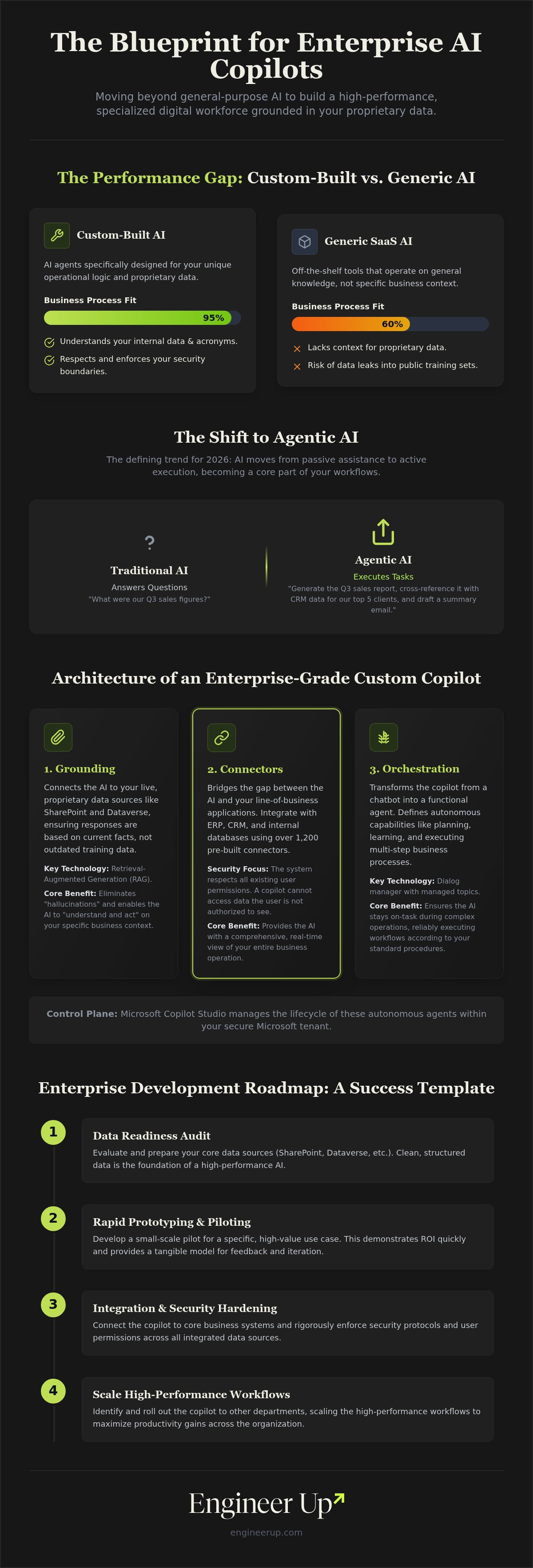
Custom-built AI systems show a 95% fit to business processes, while generic SaaS tools struggle to reach 60%. Most enterprises realize that off-the-shelf models lack the specific context needed for real work. They don't understand your proprietary data. They don't respect your security boundaries. Custom copilot development for business is no longer a luxury for early adopters. It's the standard for operational excellence in 2026. You likely feel the friction of trying to force legacy systems to talk to modern AI. It's frustrating and inefficient.
This article provides the master framework for building high-performance, bespoke AI copilots. We'll move past the hype to focus on tangible technical integration. You'll learn how to ground AI in your own data while maintaining strict security standards. We'll preview the roadmap for seamless Microsoft 365 integration and the steps to achieve measurable productivity gains. We cover everything from Copilot Studio credit management to the impact of the EU AI Act. This is your blueprint for turning raw compute into a specialized digital workforce.
Key Takeaways
• Shift from general-purpose AI to bespoke agents grounded in your proprietary data and unique operational logic.
• Master the three pillars of enterprise architecture: grounding, connectors, and orchestration using Copilot Studio as your control plane.
• Apply a rigorous evaluation framework to determine when specialized business needs demand custom development over off-the-shelf solutions.
• Execute a phased roadmap for custom copilot development for business that prioritizes data readiness audits and rapid prototyping.
• Scale high-performance workflows by partnering with specialized experts who assume the technical burden of complex AI-Apps development.
The Business Case for Custom Copilot Development
Standard Microsoft 365 Copilot is a powerful generalist. It drafts emails and summarizes meetings effectively. However, it operates primarily on general knowledge. It lacks the specific "how-to" of your internal operations. Custom copilot development for business changes the dynamic from assistance to execution. A custom copilot is an AI agent grounded in your proprietary data and unique operational logic. It doesn't guess; it knows. This distinction is critical for high-performance enterprise environments where precision is non-negotiable.
The shift toward agentic AI is the defining trend of 2026. Traditional AI answers questions. Agentic AI executes tasks. By leveraging an intelligent agent architecture, these systems act autonomously within set boundaries. They move beyond basic chat interfaces to become active participants in your business workflows. This transition allows your leadership to delegate complex, multi-step processes to an AI that understands the intent behind every instruction.
Bridging the Context Gap with Proprietary Data
Generic models struggle with internal acronyms and legacy documentation. They can't distinguish between a standard industry term and your specific project code. This is the "Context Gap." Bridging this gap requires grounding the AI in your specific SharePoint and Dataverse environments. When you ground a model in your actual data, it stops hallucinating. It moves from "search and summarize" to "understand and act." It recognizes that a specific request triggers a specific chain of events according to your company's standard operating procedures. This creates a system that isn't just a chatbot, but a functional extension of your department.
Strategic ROI: Efficiency vs. Innovation
ROI in custom AI isn't just about speed. It's about precision and structural integrity. Quantifying time saved on complex manual data retrieval provides an immediate efficiency metric. Employees spend hours digging through disparate silos for information. A custom copilot retrieves and synthesizes this in seconds. Beyond efficiency, you reduce the margin of error in specialized business reporting. High-stakes decisions shouldn't rely on generic AI interpretations. Positioning custom AI as a core component of your enterprise ai strategy ensures that innovation serves measurable business objectives. You aren't just adopting technology. You're building a competitive advantage that competitors using off-the-shelf tools cannot replicate.
Architecture of an Enterprise-Grade Custom Copilot
Enterprise-grade AI requires more than a simple prompt. It demands a structured architecture built on three pillars: Grounding, Connectors, and Orchestration. Copilot Studio serves as the control plane for this ecosystem. It manages the lifecycle of autonomous agents that interact with your core systems. High-performance custom copilot development for business in 2026 leverages multi-model support. This allows you to route tasks to GPT-5 for complex reasoning or specialized Anthropic models for high-speed processing. Security layers are integrated by design. All data residency and compliance rules remain within your Microsoft tenant, ensuring proprietary information never leaks into public training sets.
Data Grounding and Knowledge Integration
Reliability starts with data grounding. RAG (Retrieval-Augmented Generation) connects your copilot to live data sources. This ensures the AI uses current facts rather than outdated training data. You can integrate over 1,200 pre-built connectors to bridge the gap between AI and your line-of-business applications. This architecture connects your ERP, CRM, and internal databases directly to the reasoning engine. Security is paramount. The system must respect existing user permissions and security protocols. If a staff member lacks access to a specific folder in SharePoint, the copilot will not retrieve that data for them. This level of granular control is essential for successfully implementing generative AI across a global workforce.
Orchestration: From Chat to Action
Orchestration transforms a chatbot into a functional agent. It defines autonomous capabilities like planning, learning, and escalating work items. The dialog manager uses managed topics to guide the AI through specific business workflows. This prevents the model from wandering off-task during complex operations. We are seeing a rapid shift from basic assistants to custom ai chat agents for enterprise that execute multi-step processes. These agents can trigger Power Automate flows, update records, and notify stakeholders without human intervention. This level of automation requires precision. If you need a partner to build these high-stakes systems, Engineer Up provides specialized AI-Apps development to ensure your architecture is robust and scalable.
Evaluation Framework: When to Build vs. When to Buy
Most organizations start with a "buy" strategy. Standard Microsoft 365 Copilot is an excellent entry point for general administrative tasks. However, the decision to invest in custom copilot development for business hinges on the complexity of your core operations. Routine work like drafting emails or summarizing common documents is handled well by off-the-shelf tools. Specialized tasks requiring complex internal reasoning or deep legacy system integration demand a bespoke approach. You must decide if a generalist tool can truly support a specialist's workload.
Analyze your data sources with precision. If your requirements rely on publicly available information, standard models suffice. If your operations depend on highly proprietary data or siloed legacy systems, a custom build is mandatory. Research from April 2026 indicates that custom-built AI systems show a 95% fit to business processes. Generic SaaS tools typically average only a 60% fit. This 35% performance gap represents a significant loss in productivity and a higher requirement for human oversight. Building your own architecture ensures you aren't paying for a tool that only does half the job.
The "Customization Threshold" for Business
Identify the specific threshold where standard tools fail. Standard Copilot often produces hallucinations when it lacks specific business context. This is the breaking point for enterprise reliability. You must choose between declarative agents for simple data retrieval and custom engine agents for complex operations. Custom engine agents provide deeper control over the model's reasoning path and decision-making logic. This precision directly impacts operational efficiency by ensuring the AI understands the specific nuances of your workflows. When an AI can't distinguish between a standard industry term and your proprietary project code, it has crossed the threshold where customization becomes necessary.
Cost-Benefit Analysis of Bespoke Development
The total monthly cost for an E5 user equipped with Copilot is $90. For an E3 user, that cost is $69. While these per-user fees are predictable, the long-term cost of generic AI is often hidden in its inability to handle specialized logic. Initial development investment in custom AI pays off through long-term productivity gains. You eliminate the "productivity tax" associated with manual data cleaning and correcting generic AI errors. A bespoke solution is an investment in your company's unique intellectual property.
Maintenance is a critical consideration for any high-performance system. Custom solutions require ongoing support to ensure performance stability as new models like Claude Opus 5 or GPT-5 enter the market. You must avoid the technical debt of poorly architected low-code solutions. High-performance systems require professional engineering to ensure they remain stable assets rather than becoming legacy burdens. Choosing to build means assuming responsibility for the technical stack, but it also means owning the results.
The Enterprise Development Roadmap: A Success Template
Success in custom copilot development for business is not accidental. It requires a disciplined, five-phase framework. Most projects fail because they skip the foundational audit. They jump straight to building without a clear map. A structured roadmap ensures that every technical decision serves a strategic objective. This process transforms a technical experiment into a stable enterprise asset. We treat development as an engineering problem, not a creative one.
Phase 1: Discovery and Data Readiness Audit.
We identify high-value use cases and evaluate the integrity of your underlying data.
Phase 2: Prototyping and Knowledge Grounding.
We build a proof of concept grounded in your specific business context.
Phase 3: Logic Orchestration and Connector Integration.
We link the AI to your line-of-business applications and define its operational logic.
Phase 4: Governance and Security Validation.
We ensure compliance with global regulations, including the EU AI Act that took effect on August 2, 2026.
Phase 5: Deployment and Lifecycle Management.
We launch the system and initiate AI agent lifecycle management to maintain performance.
Discovery: Auditing Your Data Infrastructure
Bad data produces bad AI. You must identify "Gold Standard" data sources for grounding. This involves isolating the most accurate, up-to-date documentation within your SharePoint or Dataverse environments. Cleaning legacy data is mandatory. Outdated policies or redundant files lead to AI inaccuracies that erode user trust. We establish clear KPIs at this stage. Success isn't measured by "engagement." It's measured by task completion rates and reduction in manual effort. If your data isn't ready, your copilot isn't ready.
Iterative Deployment and Feedback Loops
Launch is not the finish line. High-performance systems require iterative refinement. "Human-in-the-loop" testing is essential during the initial rollout. We capture user interaction data to refine prompts and instructions. This constant feedback loop ensures the AI adapts to the actual needs of your workforce. Scaling from a single department to enterprise-wide availability happens only after the logic is validated. This methodical approach prevents the spread of systemic errors across the organization. If you want to move from strategy to execution, contact Engineer Up for specialized AI-Apps development.
Scaling Custom Copilots with Engineer Up
Generalist agencies often deliver superficial solutions that fail under enterprise pressure. Custom copilot development for business requires a partner with deep technical mastery of the Microsoft ecosystem. Engineer Up specializes in this niche. We assume the full technical burden of architecting and maintaining complex AI systems. This allows your leadership to remain focused on primary business goals while we ensure the stability and performance of your digital workforce. Our approach bridges the gap between legacy processes and modern AI automation. We turn outdated workflows into high-performance assets by building systems that actually understand your operational logic. We don't just talk about strategy; we execute the engineering required to make it work.
Eliminating Shadow IT Risks
Scaling AI without a central strategy invites security vulnerabilities and "Shadow AI" across departments. We eliminate these risks by centralizing governance within the Microsoft Power Platform. This ensures every custom agent adheres to your specific enterprise security standards and data residency requirements. We also manage the complexities of "Copilot Credits" and licensing costs. With the pay-as-you-go rate at $0.01 per credit or prepaid capacity packs of 25,000 credits for $200 per month, strategic management is essential to prevent budget overruns. We provide the oversight necessary to keep your AI initiatives both secure and cost-effective. This centralized approach prevents fragmented development and ensures a unified AI architecture across the entire organization.
Ongoing Support for High-Performance AI
AI agents are not static tools. They require continuous monitoring to maintain peak performance and accuracy. We provide ongoing strategic support that includes refining logic based on real-world interaction data and performance metrics. As the landscape evolves, we integrate new capabilities from the latest model releases. This includes managing the transition to GPT-5 or the recently released Claude Opus 5 from August 2026. This ensures your AI-Apps Development investment remains a cutting-edge asset rather than a legacy burden. We prioritize uptime and reliability for mission-critical automations. Your business processes don't stop, and neither should your AI. Our team handles the technical maintenance so your internal staff can focus on high-value innovation.
Securing Your Competitive Edge with Specialized AI
Standard tools provide a baseline, but the real advantage lies in precision. Custom copilot development for business transforms your proprietary data into a functional digital workforce. By focusing on robust architecture and seamless legacy integration, you eliminate the context gap that hampers off-the-shelf models. You've seen the roadmap; it requires moving from data readiness to lifecycle management. Now, the focus shifts to execution. High-performance systems require an elite partner who understands the Microsoft ecosystem's intricacies.
Engineer Up assumes the technical burden of building and maintaining these complex systems. We bridge the gap between legacy processes and modern automation with comprehensive strategy and ongoing support. It's time to move past experimentation and build for stability. Deploy your custom copilot strategy with Engineer Up and ensure your enterprise is ready for the demands of 2026. Your operational excellence starts with a bespoke architecture designed for results. The future of your workflow is autonomous; start building it today.
Frequently Asked Questions
What is the difference between Microsoft 365 Copilot and a custom copilot?
Microsoft 365 Copilot is a general productivity tool for drafting emails and summarizing meetings. A custom copilot is a specialist built for your specific business tasks. It uses your proprietary data and unique operational logic to execute multi-step workflows. While the standard version assists with general office work, a custom version connects to your internal databases. This allows the AI to perform complex reasoning based on your specific industry context.
How much data is required to ground a custom business copilot effectively?
Effective grounding requires high-quality, structured data rather than massive volume. You need "Gold Standard" documentation that accurately reflects your current procedures and policies. This usually involves isolating specific SharePoint folders or Dataverse tables for the AI to reference. Even a few dozen well-structured documents can ground an agent effectively. The focus is on data integrity. Outdated or redundant files cause inaccuracies that erode user trust and system reliability.
Can custom copilots integrate with non-Microsoft legacy systems?
Yes. Custom copilots utilize over 1,200 pre-built connectors to bridge the gap between AI and non-Microsoft applications. You can connect to ERPs, SQL databases, and various legacy systems using Power Platform architecture. If a pre-built connector doesn't exist, we build custom APIs to ensure data flow. This integration allows the AI to retrieve and update records across your entire technical stack. It eliminates manual data entry and ensures consistency across disparate systems.
What is the typical timeline for custom copilot development for business?
The typical timeline for custom copilot development for business ranges from four to five weeks. This duration includes the initial discovery phase, data readiness audit, and rapid prototyping. Complex orchestrations involving multiple agents or extensive legacy integrations may extend this period. We prioritize a phased approach to deliver a functional version quickly. This allows for iterative testing and refinement based on real-world interaction data before you initiate a full enterprise rollout.
How does custom copilot development ensure data security and privacy?
Security is managed within your existing Microsoft tenant. All data grounding and processing follow enterprise-grade compliance standards. Your proprietary information never leaks into public training sets. We implement granular access controls so the copilot only retrieves data the user is already authorized to see. This architecture ensures alignment with global regulations. It respects the EU AI Act requirements that became effective on August 2, 2026, and protects your intellectual property from external exposure.
What role does Copilot Studio play in the development process?
Copilot Studio serves as the primary control plane for custom copilot development for business. It allows us to manage the lifecycle of autonomous agents and define their operational logic. We use it to configure grounding, set up triggers, and manage orchestration. It provides the low-code interface needed to build managed topics and dialog flows. This environment ensures that your AI agents remain scalable and manageable within the Power Platform ecosystem as your business needs evolve.
Is ongoing support necessary after a custom copilot is deployed?
Ongoing support is critical for maintaining performance and reliability. AI models require continuous monitoring to prevent "drift" and ensure accuracy as new data enters the system. We provide strategic maintenance to integrate model updates like GPT-5 or Claude Opus 5. Regular refinement of prompts and logic ensures the system remains a high-performance asset. Without support, technical debt accumulates. The AI's effectiveness decreases over time as your internal processes and external technologies change.
Can I build a custom copilot without a background in coding?
Copilot Studio offers a low-code interface for basic tasks. However, high-performance enterprise applications usually require professional engineering. Complex logic orchestration and legacy system integration demand technical mastery of the Power Platform. While a non-developer can build a simple chatbot, an enterprise-grade agent requires a specialized partner. We assume the technical burden so your leadership can focus on primary business objectives while we handle the complex architecture and ongoing maintenance.
WRITTEN BY
Get Your Team AI Ready
Let's hear your use case - we'll help you get on the path to AI readiness.

FILED UNDER
TOOLS IN THIS POST

