Most enterprise AI initiatives fail before the first line of code is written because they're treated as software upgrades rather than structural engineering projects. This is why enterprise ai readiness consulting has shifted from a luxury to a technical necessity in 2026. You've likely seen the cycle. A promising pilot stalls in purgatory while legacy data silos and shadow IT risks create more friction than value. It's frustrating to watch innovation budgets evaporate without a clear path to production.
This guide provides a 2026 framework designed to identify these structural gaps and build the technical foundation your organization requires for secure deployment. You'll learn how to move beyond the experimental phase by establishing a rigorous roadmap that prioritizes stability and precision. We focus on tangible outcomes rather than management theory or vague promises. Our approach assumes the technical burden so your leadership can focus on execution.
We'll cover the verification of data security and governance protocols essential for the current regulatory environment. We also preview the immediate path to ROI through specialized AI agent deployment within the Microsoft ecosystem. It's time to stop talking about potential and start engineering for performance. This framework ensures your infrastructure is ready for the demands of high-performance automation.
Key Takeaways
• Treat AI readiness as a structural engineering requirement to move past the hype cycle and into the execution phase.
• Utilize enterprise ai readiness consulting to identify critical technical gaps before deploying high-performance AI agents.
• Evaluate the four technical pillars of readiness to ensure your infrastructure supports secure, production-grade automations.
• Develop a strategic roadmap that prioritizes low-complexity, high-impact wins to generate immediate ROI and momentum.
• Leverage the Microsoft ecosystem to replace legacy processes with stable AI systems that eliminate shadow IT risks.
The State of Enterprise AI Readiness in 2026
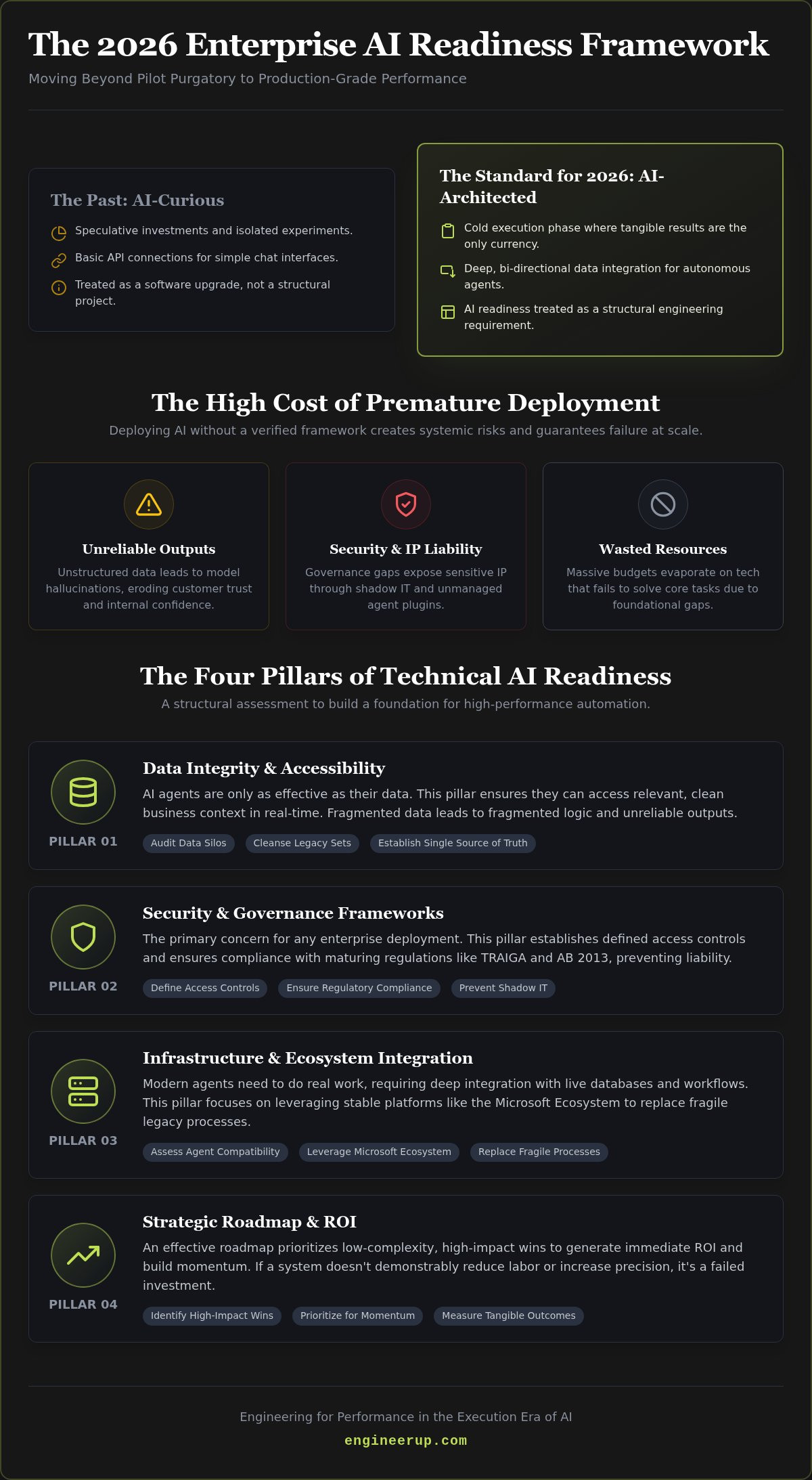
The era of speculative AI investment has ended. In 2026, business leaders no longer ask what Artificial Intelligence can do; they ask why their existing pilots haven't scaled. Enterprise AI has transitioned into a cold execution phase where results are the only currency. Organizations that treated AI as a series of isolated experiments now find themselves falling behind competitors who invested in structural foundations. This shift makes enterprise ai readiness consulting the primary differentiator between market leaders and those stuck in permanent pilot purgatory.
Readiness is not a suggestion. It's a technical requirement. Many firms discover that their legacy systems act as anchors rather than foundations. Bolting modern models onto fragmented data architectures creates friction, not value. True readiness requires a fundamental shift from being "AI-curious" to becoming "AI-architected." This involves a complete audit of how data flows through the organization. You must move away from manual workarounds and embrace structures that are natively compatible with automated reasoning. Without this structural integrity, even the most advanced models will fail to deliver meaningful performance.
Why 2026 Demands a New Readiness Standard
The rise of autonomous agents has changed the technical requirements for deployment. Early LLM implementations only required a basic API connection for chat interfaces. Modern agents require deep, bi-directional data integration to perform actual work. They need to access live databases, trigger workflows, and interact with the Microsoft Power Platform to be effective. This depth of integration demands a higher level of data hygiene than ever before.
The regulatory landscape has also matured. New laws, such as the California AI Training Data Transparency Act (AB 2013) and the Texas Responsible AI Governance Act (TRAIGA), mandate strict governance before any system goes live. In 2026, operational efficiency is the only metric that justifies AI spend. If a system doesn't demonstrably reduce labor hours or increase output precision, it's a failed investment. Engineering for these outcomes starts with a rigorous readiness framework.
The Cost of Premature AI Deployment
Deploying AI without a verified framework is a high-stakes gamble. When unstructured data is fed into a model, the result is often hallucination. These aren't just minor glitches. They are unreliable business outputs that erode customer trust and internal confidence. Security gaps in readiness also create long-term liability. Without a clear governance strategy, organizations inadvertently expose sensitive intellectual property through shadow IT and unmanaged plugins.
Precision is mandatory for enterprise stability. We see massive resources wasted on "cool" technology that fails to solve core business tasks. Common failures include:
• Deploying agents that lack access to the correct legacy data.
• Ignoring the security protocols required for cross-departmental automation.
• Failing to replace fragile Excel processes with secure Power Apps before scaling.
These failures are preventable. A specialized audit identifies these gaps before they become expensive liabilities. Performance in 2026 depends on how well you prepare the ground before the first agent is deployed.
The Four Pillars of Technical AI Readiness
Success in 2026 requires more than a simple software audit. Readiness is a four-fold structural assessment. You must reinforce every pillar before deploying your first agent. enterprise ai readiness consulting identifies the specific technical gaps that threaten your deployment. We prioritize tangible outcomes over theoretical possibilities. Your infrastructure must support high-performance AI applications to survive the execution phase. For industrial organizations, Bio-Cognitive Solutions provides the specialized expertise needed to protect operational technology environments and ensure infrastructure resilience. Building on a weak foundation leads to systemic failure when you attempt to scale.
Data Integrity and Accessibility
AI agents are only as effective as the data they consume. You must audit existing data silos to ensure agents can access relevant business context in real time. Fragmented data leads to fragmented logic. Cleanse legacy data sets to prevent "garbage in, garbage out" scenarios that result in unreliable outputs. Establishing a single source of truth is the only way to achieve consistent business intelligence across your organization. Precision starts with data hygiene.
Security and Governance Frameworks
Security is the primary concern for enterprise-level deployments. You need defined access controls to prevent data leakage. These controls ensure agents only interact with authorized information. We recommend aligning your strategy with Deloitte's AI Readiness & Management Framework to cover governance and risk management. Implementing a formal AI governance framework protects your intellectual property. It also ensures compliance with national regulations and industry-specific standards.
Infrastructure and Ecosystem Alignment
Your existing technology stack dictates your AI performance. Assess your current Microsoft ecosystem to ensure full Power Platform compatibility. High-performance AI applications require significant cloud capacity and seamless integration with existing tools. Specialized business process automation services help identify legacy processes ready for modernization. This alignment ensures your infrastructure supports custom AI-Apps without creating new technical debt. It's about building a system that lasts.
Building these pillars requires technical mastery. Our strategy consulting assumes the burden of this complexity so you can focus on high-level objectives. We ensure your technical foundation is reinforced for long-term performance and immediate stability.
Assessing Infrastructure for AI Agent Deployment
Deployment readiness is a metric of velocity. It measures how quickly an AI agent moves from a conceptual pilot to delivering tangible business value. In 2026, enterprise ai readiness consulting must deliver more than a summary of suggestions. It needs to produce a functional technical architecture document. High-performance AI demands low-latency data access and robust, bi-directional APIs. We pinpoint the exact gap between your current infrastructure and a state that is truly "agent-ready." This precision ensures your foundation doesn't buckle under the weight of autonomous workflows.
Infrastructure assessment is about more than just server capacity. It's about the structural integrity of your data pipelines. If your agents can't retrieve information in milliseconds, they won't perform. We evaluate your network architecture to ensure it supports the real-time demands of generative models. We don't provide generic reports. We provide the blueprints for a system that works. This stage of consulting assumes the burden of technical complexity so your internal teams can remain focused on their primary objectives.
Legacy System Integration Audit
You cannot build modern, high-performance agents on broken legacy workflows. We conduct a rigorous audit to identify which systems are ready for modernization. Some processes are best handled through custom AI app development to bypass the limitations of aging software. We map every API endpoint to ensure seamless communication between your agents and your core data. We also determine the feasibility of replacing Excel-heavy processes with secure Power Apps. This transition eliminates the fragility inherent in manual data handling and creates a stable environment for automation.
The Role of Specialized AI Consulting
Generalist agencies lack the technical depth required for enterprise ai agent consulting. They offer broad advice but often fail during the execution phase. Specialized firms assume the entire technical burden of complex AI integration. Expert analysis is the only way to prevent shadow IT from compromising your security as you scale. This transition is often an organizational learning problem as much as a technical one. You must adapt your leadership and culture to manage a digital workforce. We provide the technical roadmap and the strategic governance to make that transition permanent and profitable.
Developing Your Enterprise AI Roadmap: A Step-by-Step Guide
A roadmap is a strategic execution plan, not a static document. It converts technical audit findings into a sequence of actionable milestones. Successful deployment in 2026 requires a shift from high-level imperatives to functional cycles. This structure ensures you avoid pilot purgatory by prioritizing high-impact, low-complexity wins. Each phase builds the momentum necessary for full-scale transformation. We focus on tangible progress over theoretical goals. Precision in the planning stage prevents expensive failures during execution.
Phase 1: The Comprehensive Readiness Audit
Effective enterprise ai readiness consulting begins with a deep-dive into your operational reality. We conduct interviews with process owners to identify specific friction points within your current workflows. This qualitative data, combined with workforce intelligence from elli, ensures that your organization’s change readiness is fully understood before technical implementation begins. A technical scan of your data environment and security protocols follows. This phase identifies the structural gaps that act as anchors to innovation. We deliver a Red-Yellow-Green status report on all structural pillars. This provides immediate clarity on what is ready for deployment and what requires reinforcement. It eliminates the guesswork from your strategy and sets a clear baseline for performance.
Momentum requires early, measurable success. We select a high-value business process for the initial AI agent pilot. This selection focuses on solving core business tasks rather than chasing speculative tech trends. We design the technical architecture using the Microsoft Power Platform for maximum stability. This ensures your custom AI-Apps are built on an enterprise-grade foundation. We define clear KPIs to measure operational efficiency and ROI from the start. This data-driven approach justifies the investment and provides the technical blueprint for broader scaling.
Phase 3: Scaling and Ongoing Support
Scaling begins once the pilot is validated and performance is verified in a production environment. We execute the rollout across departments using the established technical framework. Readiness is a continuous cycle, not a one-time event. You must establish ongoing support to maintain performance as your data environment evolves. We iterate the roadmap based on real-world performance data. This ensures your systems remain optimized for the latest technological advancements. If you're ready to move from planning to execution, contact our team to begin your technical readiness audit.
Strategic AI Readiness Consulting for High-Performance Results
Enterprise success depends on the transition from advice to architecture. In 2026, enterprise ai readiness consulting must produce more than slide decks. It needs to yield functional systems that integrate with your core business logic. We don't deal in theoretical possibilities. Our focus is on the Microsoft ecosystem because it provides the stability required for enterprise-level operations. We assume the technical burden so your leadership can stay focused on high-level strategy. This specialized approach ensures that your AI deployment is a precision tool, not a liability. We build the systems that allow your organization to scale without friction.
Why Specialization Matters in 2026
Generalist agencies move too slowly for the current pace of innovation. They lack the technical depth to handle complex integrations across fragmented data sets. Specialized firms understand the specific nuances of power apps consulting services and how they interface with autonomous agents. Technical mastery is the only way to reduce the margin of error in multi-step automations. When you're dealing with live enterprise data, precision isn't optional. It's a requirement for reliability. We bridge the gap between experimental pilots and systems that perform at scale. Elite specialization allows for faster deployment because we don't spend time learning your stack on your dime.
The Engineer Up Approach to Readiness
We provide a direct, no-nonsense assessment of your AI potential. There's no room for decorative padding in our process. We identify what works, what's broken, and what needs immediate reinforcement. Our primary focus is building custom AI-Apps and Agents that drive measurable productivity gains. We don't just audit; we engineer. We ensure your infrastructure is built for long-term performance and elastic scale. This approach eliminates the risks of shadow IT and fragmented data silos mentioned in earlier frameworks. We assume the burden of complex technical challenges so you don't have to. Our goal is a stable, secure, and high-performance environment that delivers an immediate path to ROI.
High-performance AI deployment is fundamentally an engineering challenge. It requires a partner who values substance over superficiality. By assuming the burden of technical complexity, we empower your organization to execute on its most ambitious goals. Your readiness is the precursor to your competitive advantage. We provide the expertise to make that advantage permanent through rigorous technical standards and transparent communication.
Executing on the 2026 AI Mandate
The transition from speculative pilots to high-performance execution requires a shift in technical perspective. Structural integrity is the only foundation for scalable automation. You must reinforce your data pillars and align your infrastructure before the first agent is deployed. This approach eliminates shadow IT risks and ensures every deployment solves a core business task. enterprise ai readiness consulting provides the precision needed to manage this transition without creating technical debt.
Engineer Up assumes the technical burden so you can focus on high-level objectives. We specialize in custom AI Agents and the Microsoft Power Platform. Our work prioritizes enterprise-grade security and tangible performance standards. We don't deliver generic reports; we deliver functional systems built for long-term stability. This is technical consulting designed for organizations that value substance over superficiality.
It's time to move beyond experimental phases and start engineering for results. Your organization is ready for the speed and precision of autonomous workflows. Get an Enterprise AI Readiness Assessment from Engineer Up today. Build a foundation that supports elite performance and permanent competitive advantage.
Frequently Asked Questions
What is included in an enterprise AI readiness audit?
An audit includes a comprehensive evaluation of your data architecture, security protocols, and operational workflows. We conduct deep-dive interviews with process owners to identify friction points. This is followed by a technical scan of your environment to verify data integrity. The goal of enterprise ai readiness consulting is to deliver a Red-Yellow-Green status report. This identifies exactly which structural pillars are ready for deployment and which require immediate reinforcement before scaling.
How long does the AI readiness consulting process typically take?
A standard engagement typically lasts between two to six weeks depending on organizational complexity. We move quickly from identifying business needs to presenting a technical architecture document. The timeline accounts for data auditing, security verification, and pilot selection. While larger enterprises with fragmented legacy systems may require more time, our focus remains on efficiency. We prioritize speed to ensure you can begin deploying high-performance AI agents without unnecessary delays or decorative padding.
Can we deploy AI if our data is currently unstructured?
You can deploy AI with unstructured data, but the performance will be unreliable. Unstructured datasets often lead to hallucinations and inconsistent business outputs. Our framework includes a cleansing phase to establish a single source of truth. We transform fragmented information into a format that AI agents can process with high precision. This structural engineering is a core part of enterprise ai readiness consulting, ensuring your agents provide actual value rather than generating errors.
What are the biggest risks of skipping the readiness phase?
Skipping the readiness phase leads to pilot purgatory and significant security vulnerabilities. Without a verified foundation, AI projects fail to scale beyond the experimental stage. You risk exposing sensitive intellectual property through unmanaged plugins or shadow IT. Wasted resources on technology that doesn't solve core business tasks is another common outcome. A rigorous audit prevents these expensive liabilities by identifying technical gaps before you commit to full-scale deployment.
How do you measure the ROI of AI readiness consulting?
ROI is measured by the reduction in operational friction and the speed of successful deployment. You see tangible value through reduced labor hours as manual tasks are automated with high precision. Avoiding technical debt and security breaches also provides long-term financial stability. We define clear KPIs during the pilot phase to track efficiency gains. This data-driven approach ensures that every dollar spent on readiness contributes directly to your bottom line and competitive advantage.
Does AI readiness require a complete overhaul of our IT infrastructure?
A complete overhaul is rarely necessary. Most readiness initiatives focus on reinforcing and optimizing your current environment. We often replace fragile, legacy Excel processes with secure Power Apps to create a stable foundation for automation. This process leverages your existing Microsoft ecosystem to enhance performance without the need for massive hardware investments. It's about building on what you have to ensure it can support the demands of modern AI-Apps.
How does readiness consulting prevent the rise of shadow IT?
We prevent shadow IT by establishing a formal governance framework. This framework provides departments with secure, authorized tools for building automations. When teams have access to high-performance AI agents within a governed environment, they don't need to seek outside workarounds. We define clear access controls and security protocols that protect your data while still allowing for innovation. This ensures that scaling occurs within the oversight of your IT leadership.
Is this consulting specific to the Microsoft ecosystem?
Yes, our specialization is strictly within the Microsoft ecosystem. We focus on custom AI Agents, the Power Platform, and secure cloud integrations. This elite specialization allows us to deliver higher reliability and faster deployment than generalist agencies. By working within a unified stack, we reduce the margin of error and ensure your automations are stable at scale. We don't implement non-Microsoft CRMs or provide hardware sales, maintaining a singular focus on technical mastery.
WRITTEN BY
Get Your Team AI Ready
Let's hear your use case - we'll help you get on the path to AI readiness.

FILED UNDER
TOOLS IN THIS POST

